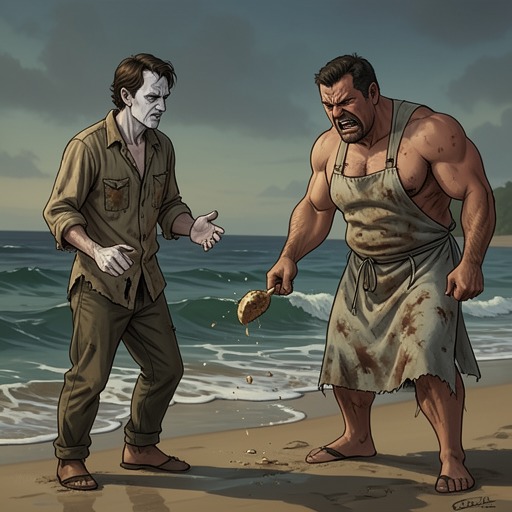
Pi Kills the Cook and Eats His Body
Life of PiPi Kills the Cook and Eats His Body is the decisive act of violence in Pi Patel’s human version of the events at sea. The Cook first sustains Pi when he is too weak to leave the raft, giving him turtle blood and food; later, Pi kills him and eats from his body. Pi presents the act not as a clean escape from evil but as an ordeal that leaves him confronting the same selfishness and ruthlessness he had condemned in the Cook. The account ends with solitude, a turn toward God, and survival, making the killing both a physical rupture and a lasting moral burden.
Dependence and Conflict
The account begins this episode the morning after Pi has spent the day and night on the raft, watching the Cook. Pi says the Cook could have cut the raft loose but did not. In the morning, while the Cook remains in plain sight, Pi pulls himself along the rope and boards the lifeboat. He is very weak, and the Cook says nothing. Pi, too, keeps silent. Their restraint is not reconciliation: the scene establishes a tense coexistence in which neither speaks, even as the Cook’s actions continue to shape Pi’s chances of surviving.
The Cook catches a turtle and gives Pi its blood. He butchers it and places its best parts on the middle bench for Pi to eat. This exchange is a concrete reversal in their immediate relation: the Cook, whom Pi later describes as evil, provides food to a weakened companion. The detail does not erase the conflict that follows, nor does the account explain the Cook’s reasons for helping him. It instead preserves the uncomfortable fact of dependence. Pi receives care from the person he will soon kill, and the episode makes survival inseparable from a relationship that cannot be described in simple terms of victim and enemy.
The Killing
Pi reports that he and the Cook then fight and that Pi kills him. He characterizes the Cook as giving up, while still resisting physically, and interprets this surrender as recognition that he had gone too far. Pi also notes that the Cook offers no apology. The account does not settle what the Cook intended or understood; it presents Pi’s reading of his silence and surrender as part of the event’s moral aftermath.
The knife had been visible on the bench all along. Pi says both men knew it was there and that the Cook had put it there. Pi takes it and uses it against the Cook. When the Cook remains standing, Pi continues; a slight lift of the Cook’s head becomes a gesture Pi tries to interpret, though he cannot establish its meaning. The Cook says nothing before he dies. These details make the knife’s presence and the men’s silence central to the scene: the weapon is not introduced at the last moment, and the final encounter yields no spoken explanation or reconciliation.
Survival and Its Cost
After killing the Cook, Pi eats from his body. He describes the act alongside other acts of making food available from what is at hand, including the earlier turtle. The comparison is not presented as a return to ordinary eating. Instead, it records how radically survival has altered the conditions under which Pi acts. His account gives the physical fact without turning it into a claim that the killing was harmless or that necessity has made it morally simple.
Pi’s own judgment is explicit: the Cook was evil, but he met evil in himself as well, in selfishness, anger, and ruthlessness. He says he must live with that recognition. The admission prevents the event from ending with the Cook’s death as though the source of danger had simply been removed. Pi survives, but the act remains part of his understanding of what survival demanded and what it exposed in him.
Solitude and Narrative Meaning
Pi describes solitude as beginning after the killing. He turns to God and says that he survives. The sequence gives the episode a stark aftermath: violence does not restore companionship or bring an explanation from the dead man; it leaves Pi alone, with faith as the response he names and survival as the outcome. The account does not say that faith cancels his responsibility or resolves his self-reproach.
As Pi’s human account of his ordeal, the episode also changes the emphasis of the story he is telling. The Cook’s provision of food, Pi’s dependence, the fight, the killing, and the eating remain together in one sequence, rather than allowing the final act to stand apart from its circumstances. Pi’s recognition of the Cook’s evil becomes inseparable from recognition of his own capacity for violence. What follows is not an easy absolution but an acknowledged burden: he must continue living with what he did. The event therefore marks both the end of this conflict and the beginning of the solitude through which Pi says he turned toward God and survived.